Birds, Traffic, Machines
RiR # 99, S14, E07, July 20, 2026
Connecting sounds in new and exploratory ways
Soundscapes, from Dubai, UAE, Vancouver, Washington, and Victoria, Canada, all by John Barber, woven by him as a sonic tapestry. "Dawn Birds, Light Traffic, Melodic Machines." From our RiR Workshop series, a laboratory for experimental sound-based storytelling.
The purpose of this episode is two-fold. To provide a listening experience focused on what stories might be told from what you hear. And, to establish the concept of Soundscape as a basis for telling stories using sounds other than human voice.
Access the episode script

Background
Quick Info
"Dawn Birds, Light Traffic, Melodic Machines"
RiR Workshop
Sound tapestry woven of soundscapes from Dubai, Vancouver, Victoria
Previous Iteration
Framework Radio #808, July 3, 2022. Learn
more at the Framework
website→
Three soundscapes recorded by John Barber. One in Dubai, UAE. Another, recorded in Vancouver, Washington. And a third, recorded in Victoria, British Columbia, Canada. Barber weaves these soundscapes into a single sonic tapestry where the narrative is based on mechanical and environmental sounds, rather than human dialogue.
Production
Contents
"Dawn Birds, Light Traffic, Melodic Machines" features field recordings made in Dubai, UAE, Vancouver, Washington, and Victoria, Canada, by John Barber. These contents were first heard as episode #808, July 3-11, 2022, on Framework Radio, broadcast on radio art stations around the world.
Statement
At the heart of every soundscape is the idea of sounds that might be heard at a particular place and time. But sounds recorded in different places and at different times can connect through similarity, serendipity, and synchronicity. This project explores how those connections can create meaningful experiences and suggest narratives without relying on human speech This gives the field recordist and/or sound artist large latitude. Including creating collages of sounds heard in different places at different times. This helps produce compositions interpreting, describing, and documenting a place, in time, over time. And promote the sense of realism conveyed by the soundscape.
Sounds recorded at one location, at one time, may connect, through either sonic similarity or serendipity, with sounds recorded at another location, at a different time. The results are sonic tapestries representative of fluid time and place but solidly grounded in rich listening experiences.
This realism evolves from the process of making and considering what is captured by the the field recordist's microphone. In my practice, composing a soundscape is often a process of selecting, editing, and juxtaposing elements of different recordings made at different times to create a sense of a place, to promote a believable experience of being in that space. This sense of structure and reality comes from active aural engagement for both myself and those listening to my works.
"Dawn Birds, Light Traffic, Melodic Machines," seeks to provide a constructed scenario that connects realistic sounds in new and exploratory ways. That asks listeners to pay attention to aural details of different, often divergent, acoustic environments. And find in their overlap and interplay connecting dialogue.
Soundscapes then not only provide ways of understanding places through their sounds, but prompt listeners to explore new ways of understanding those places through listening. "Dawn Birds, Light Traffic, Melodic Machines" offers two opportunities for listeners.
First, it foregrounds the aural world. This pushes one to listen to and contemplate the sounds that might be heard.
Second, it helps listeners engage with unique features and affordances of the sonic environment. To cultivate ways of hearing dialogs between the sonic elements of that environment. Stories told with sounds other than human voice.
Significance
"Dawn Birds, Light Traffic, Melodic Machines," is the first in a new series we're calling "Re-Imagined Radio Workshop." The word Workshop implies experimental sound-based storytelling.
For this first episode, we begin with Richard Hand's and Mary Traynor's positioning of speech, sound, music, and silence as the "constituent parts" of radio drama (Hand, Richard J. and Mary Traynor. Radio Drama Handbook: Audio Drama in Context and Practice. Continuum International Publishing Group. 2011, 40).
Traditionally, speech carries the greatest weight in storytelling because it is our primary form of communication. This work asks listeners to consider whether other sounds can also communicate meaning, emotion and story. The narrative is ultimately created through the listener's imagination.
"Dawn Birds, Light Traffic, Melodic Machines" is an answer to that question. Woven from three distinctly different soundscapes. Each recorded at different times and places. This work privileges environmental and mechanical sound sources, rather than human speech, as its "constituent parts."
Despite this separation, this work offers sonic simularity, synchronicity, and serendipity sufficient to promote a sense of narrative completeness.
Producer's Notes
Traditionally, speech is weighted more heavily when considering sound-based storytelling, as this is the primary form of human communication. But other sounds, and music, even silence are part of the mix.
Episodes of our new "Re-Imagined Radio Workshop" series are meant to encourage active listening to sounds around you and imagining stories in what you hear.
I've imagined a story to help start your thinking.
In another dramatic turn in the global battle over soundscapes, Captain Craig McKenzie and his crew from the fabulous submarine Omega have recovered a cache of them hidden in a cave behind Yellowstone's Undine Falls.
The Secret Society for Sonic Sobriety claimed responsibility for the auditory heist. Their efforts to cleanse the world of unwanted soundscapes will continue, they say, with removal of any soundscape that fails to uphold their sacred scripts. Brave Sonic Soldiers will continue these audacious operations, the Society stated in an official statement.
Soundscapes, acoustic snapshots of natural, environmental, and human activity at specific places and times, are stolen by the shadowy Secret Society. Imprisoned in empty Chambord whiskey bottles and defiantly sealed with corn cob plugs, stolen soundscapes have been found hidden in abandoned subway tunnels, civic monuments, underground lava tubes, and decaying attics. Many have been unearthed buried in steel boxes beneath isolated fields and pastures.
McKenzie and his crew found hundreds of soundscapes hidden in a cave behind Yellowstone's Undine Falls, a popular roadside stop for tourists. The cave was carved from the volanic basalt by the waters of Lava Creek for millennia.
Turning the rescued soundscapes over to Yellowstone authorities, McKenzie declared: "We will travel to the ends of the Earth from our headquarters in Latitude Zero to recover and return stolen soundscapes. A world without soundscapes is a world of diminished imagination!"
"These soundscapes are the living tissue of human connection," McKenzie said. "Hearing the distinct sounds of different cultures and places is to better understand them. Understanding and accepting unites humanity! The Society wants to break that bond. They want isolation and rigid control. We fight for empathy and global connection through sound diversity. We will prevail."
Now it's your turn. Listen and imagine. And if you like, let us know your story.
The launch of Re-Imagined Radio Workshop series reflects our continued exploration of new forms of sound-based storytelling. Future RiR Workshop editions will feature soundscapes, sound walks, sound spas, sound-based narratives, and experimental radio theatre designed to encourage active listening and creative engagement with sound. Each a curated listening experience designed to expand our sound-based storytelling, and leave you feeling refreshed. Relaxed. Re-energized for what lies ahead.
Now, get comfortable and listen as Re-Imagined Radio presents "Dawn Birds, Light Traffic, Melodic Machines."
Thank you for listening.
— John F. Barber
Soundscapes
Acoustic environments/spaces are built or natural places where sounds (human, mechanical, environmental) as they are modified by the environment of those places MIGHT be heard. Note the emphasis on the potential.
A soundscape is the sounds that ARE heard in a particular acoustic environment/space by a person in that context. Note the emphasis on the physical.
Often, soundscapes are recorded, as are those in this episode of Re-Imagined Radio.
Learn more about acoustic environments/spaces and soundscapes, and listen to examples here→
Promotion
Press
Graphics
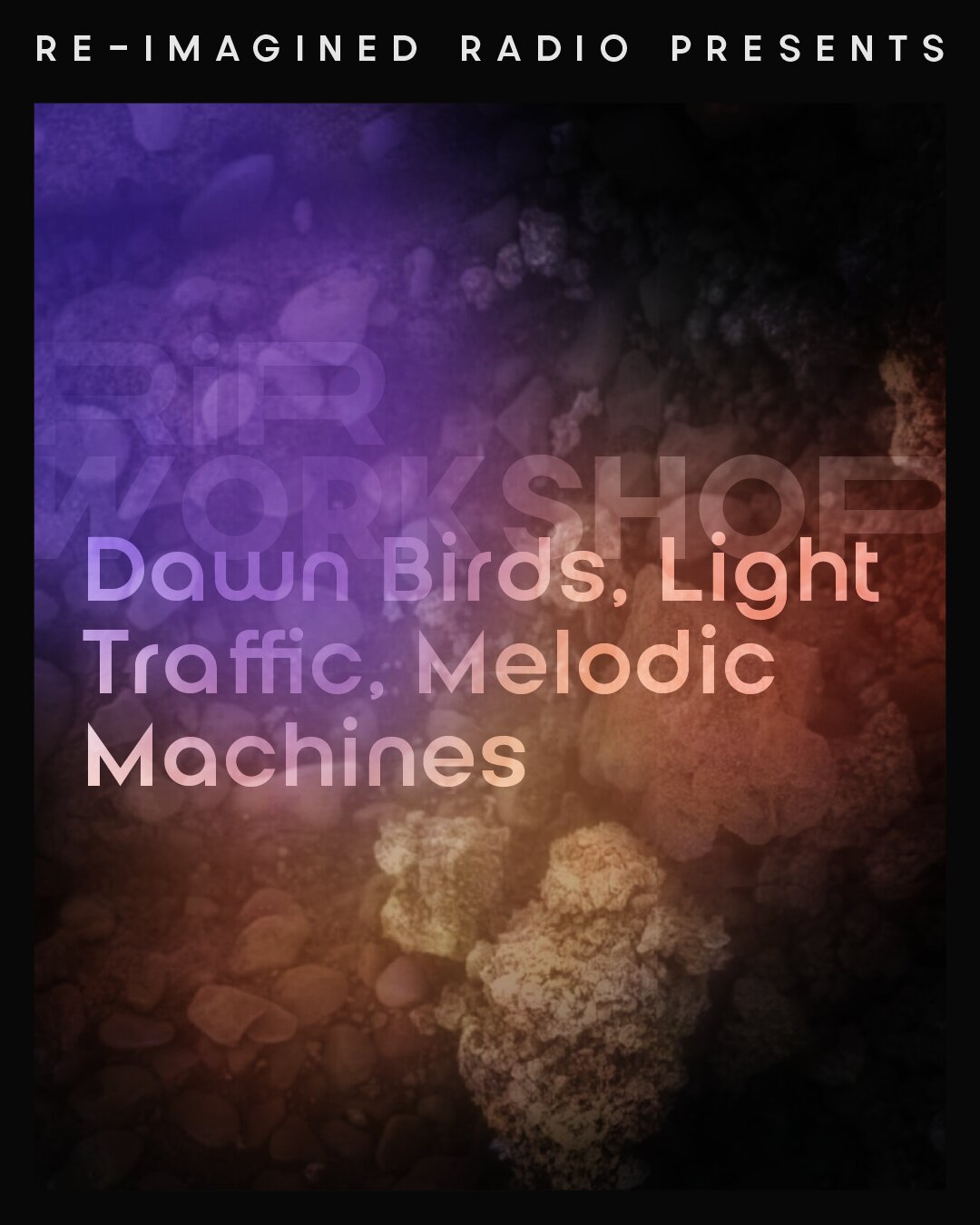
The background image is "Private Joseph Field," a combination of four photographs by NASA's Mars
Exploration Rover Opportunity, along the Western edge of Endeavor Crater, Oct. 2, 2016.
Image Source: NASA/JPL-Caltech/Cornell/USGS/Arizona
State University→
Image Status: Public Domain.
Looking for other graphics to promote this episode?